
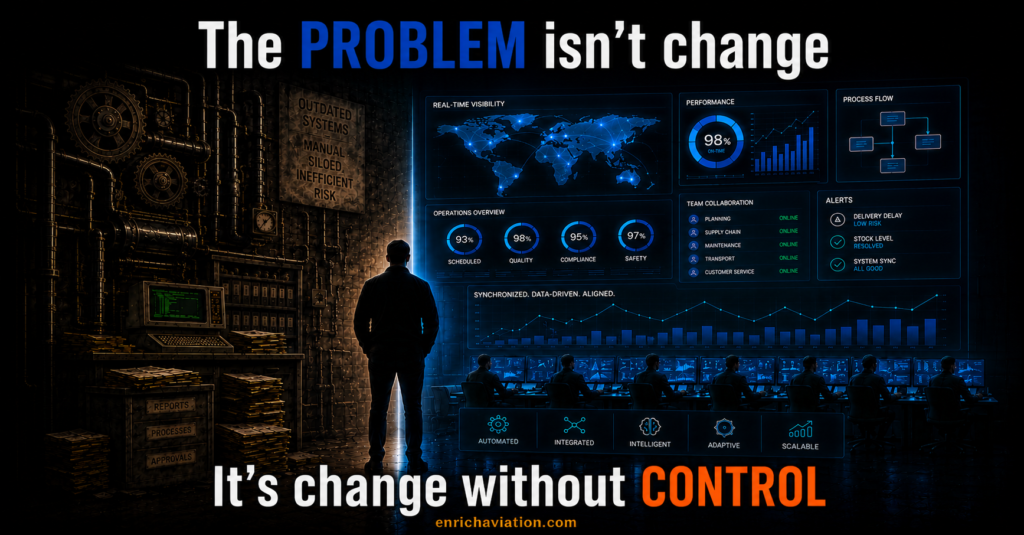
Change Management: Moving Fast Without Losing Control
Lever 2 of the X-OPS Framework Series
In operations, change isn’t a phase—it’s a permanent state.
Whether you’re rolling out new systems, integrating acquisitions, or responding to unexpected disruptions, change hits hard and often. And too often, it hits without a plan.
But here’s the hard truth: organizations don’t fail because they change too much. They fail because they don’t change well.
In the X-OPS Framework, Change Management is not a support function—it’s a strategic capability, baked into how high-performing operations evolve, stay aligned, and deliver value under pressure.
⚠️ When Change Goes Sideways
You’ve probably seen it:
- The “top-down surprise”—where leadership unveils a change with zero context or input, and teams freeze in confusion.
- The “flood”—when five initiatives are rolled out at once, overwhelming frontline teams with no prioritization.
- The “silent fail”—where no one speaks up, no one owns the outcome, and the change fizzles behind the scenes.
- The “one-size-fits-all” approach—where complex changes are managed like compliance checklists, ignoring nuance, risk, and people.
These are not people problems. They’re process problems.
Here’s an example of what I once encountered.
In the aviation industry, planners study new markets to expand the airline’s route network. In their push to commence commercial operations, other departments struggle to keep up with the launch of new flights to the new market. Flight crew resources couldn’t keep up. Procurement contracts cannot be concluded in time. Safety & Security arrangements are compromised. Ground staff training lagged, Call Centers struggled to cope. Multiple delays and incidents suddenly crept in and everyone struggled with firefighting. The result? Reputational damage, poor sales and low passenger load factors, consequential impact on aircraft utilization and other more profitable routes.
In another example, when a company decided to introduce a new product, management decided that the final assembly work was to be managed by a section that was not involved in any production process at all. In fact, the section’s primary function was to receive components and ensure that the components met the specifications. It was convenient for management to push the final assembly function to this section because it had more staff resources and the final assembly location was geographically “convenient”. Needless to say, staff were poorly equipped, managers and supervisors weren’t competent, and failures occurred. Furthermore, management didn’t track performance carefully, and morale dropped across the board. It wasn’t until things came to a head that management finally decided that it was better to move the function to a better resourced section, and implemented a thorough change management process that ensured success.
In more recent times, in what looked like a straightforward exercise of improving systems, some “missteps” caused significant public uproar. In hindsight, those “missteps” might have been better managed. Read more about these change management examples here.
✅ What Great Change Looks Like
When done right, Change Management is a system of discipline and empathy. It enables speed, protects focus, and builds buy-in. Here’s what it looks like in action:
- 🧭 Strategic alignment – Change initiatives clearly link to the organization’s operational and customer value goals.
- 🤝 Early and continuous stakeholder engagement – Stakeholders are involved not just informed.
- 📊 Risk-aware planning – Operational, people, and reputational risks are mapped and mitigated from day one.
- 📣 Clear, consistent communications – Everyone knows what’s changing, why, and how it impacts them.
- 🧠 Change capacity management – Leaders monitor organizational bandwidth to avoid fatigue and overload.
🧱 Build a Repeatable Change Management Process
Here’s how to systematize change so it’s not chaotic, reactive, or personality-driven:
1. 🗺️ Map the Change Process
- Introduce a 5–6 step framework (e.g., Initiate → Assess → Engage → Implement → Sustain → Review)
- Include a visual diagram or flowchart. Tools such as Swimlane Diagrams, simple Flow Charts or Value Stream Mapping are ideal for visualising end-to-end processes.
2. Assess the Risks
Before you start creating Gantt charts, assess change risk:
- What could go wrong—operationally, reputationally, culturally, financially?
- Who stands to gain, and who feels like they might lose?
- What existing weaknesses could be exposed by this change?
Embed Risk Management into every stage of change—not just the compliance box-tick at the end. Many Risk Assessment tools exist, and each one for different purposes. At the end of every risk assessment and mitigation plan, record these in a corporate Risk Register, which should be reviewed from time to time.
2. Segment Your Stakeholders
Knowing and managing your internal and external stakeholders is key to ensuring that changes are supported across the board. Map out key internal and external stakeholders:
- Sponsors – Executives with authority and budget.
- Influencers – Trusted mid-level leaders and informal gatekeepers.
- Implementers – The people doing the work.
- Resisters – People likely to be sceptical, overloaded, or politically exposed.
- External – Government agencies, regulators, vendors, and customers
Design your engagement plan around these groups. Not everyone needs a roadshow—some need 1:1 conversations, co-design sessions, or early demos.
Among these stakeholders, some of the most challenging ones come from the resisters group (both internal and external), who put roadblocks every step of the way. Knowing what their motivations are is one key to reducing their reluctance to change, and can make a big difference between a successful and a sluggish outcome.
3. Build a Change Communications Playbook
Your comms isn’t a memo—they’re the narrative.
- What’s changing
- Why now
- What’s not changing
- What success looks like
- What help is available
Use multi-channel, multi-format messaging, whatever tools you can avail of —slides, workshops, Q&A, short videos, embedded updates in team meetings. Repetition matters. So does tone.
And always close the loop: show what you’ve heard and how it’s being acted on.
4. Integrate Into Routines
Change efforts die when they sit in a separate lane. Embed them into your:
- Daily standups
- Weekly ops reviews
- One-on-ones
- Reporting dashboards
- Performance feedback loops
Make it impossible to ignore—and easy to stay updated.
5. Track Impact, Not Just Milestones
A Gantt chart won’t tell you if people are confused, disengaged, or silently resisting.
Use pulse surveys, team feedback, engagement metrics, and direct observation to assess adoption—and iterate fast.
🔁 Change as a Permanent Operating Rhythm
In the X-OPS model, Change Management is not a series of isolated projects—it’s a core discipline that strengthens:
- Resilience under pressure
- Alignment across functions
- Trust between leaders and teams
- Speed without chaos
It’s about building an operational culture where change isn’t feared, it’s fluent.
Document, Document, Document
It’s easy to forget the lessons learnt with every change management process, what the risks were and how they were mitigated or overcome. As the organisation grows, the changes and processes made may no longer be relevant for the new circumstances. Documenting every step of the process, right from the beginning (Risk Assessment), helps each succeeding generation of leaders understand.
Remember, whatever processes are implemented must be documented, and whatever is documented must be implemented. Only then can any gaps be closed.
💬 Final Thought:
If culture is the engine of operations, change management is the steering system.
Without it, you might still be moving—but you’ve lost control.
📍 Next in the Series: Collaboration & Communication – Breaking Silos Before They Break You